Challenge
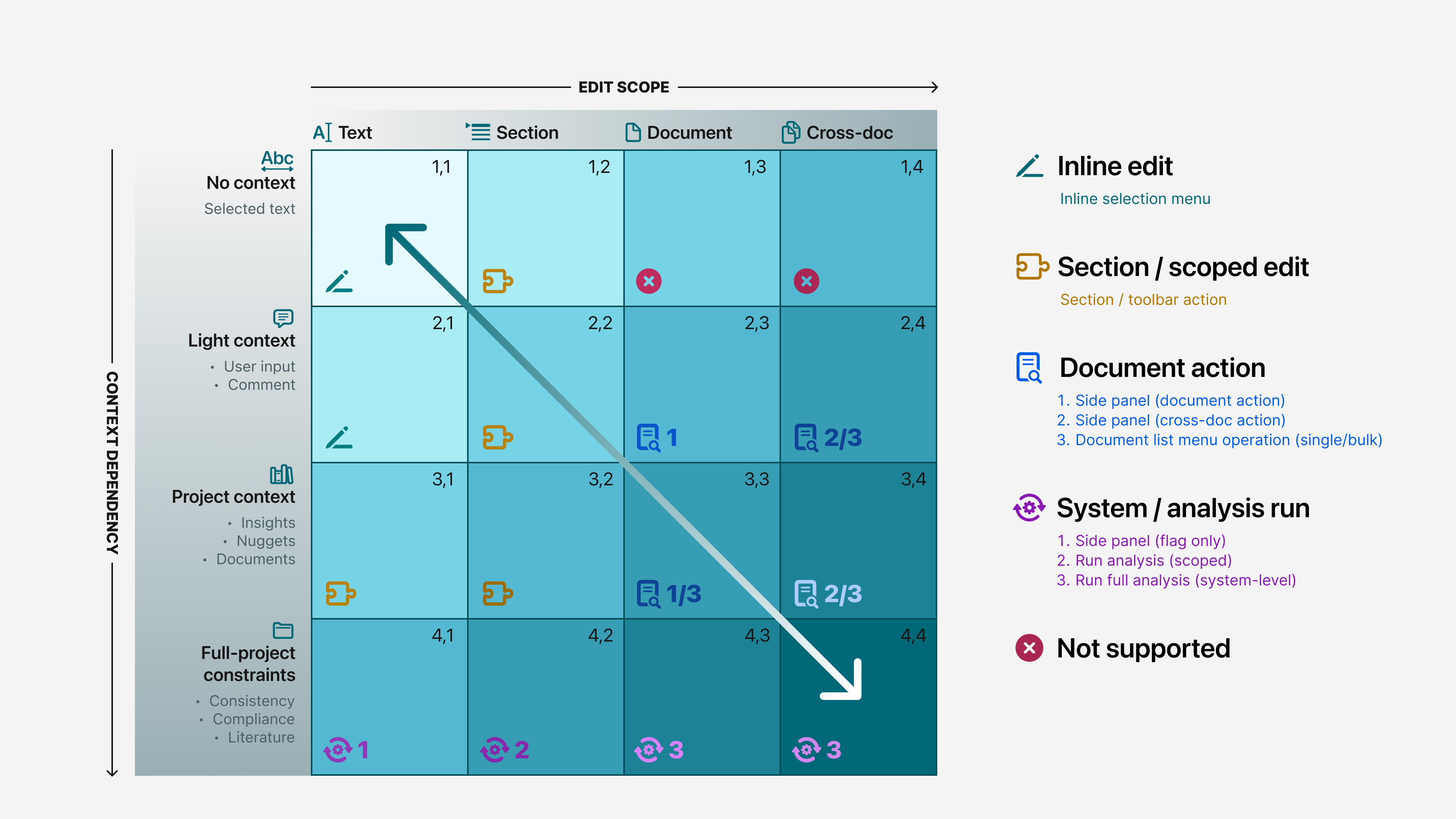
AI editing was introduced as a broad capability without clear boundaries. Requests ranged from rewriting a sentence to modifying entire documents across contexts. Without defined scope, edits could become hard to understand, verify, or control, especially in a high-stakes workflow.
Decision
AI editing should not operate as an open-ended capability. It must be bounded by how much it changes and what context it relies on. Structured editing across scope and context to make risks and dependencies explicit, turning a vague capability into a set of controlled scenarios. This enabled the team to prioritize safe cases, defer high-risk ones, and move forward without premature UI commitments.