In today’s digital economy, the issue of monopolies by large technology companies has captured global attention. These corporations not only hold vast market shares but also influence the pathways of innovation and consumer choices. The internet, being central to modern life, intensifies the impact of these monopolies, challenging multiple domains from individual privacy to business competition. Monopolies restrict market competition, stifle innovation, and exacerbate social and economic inequalities, making them complex societal issues that require multifaceted strategies to address.
Confronting such complex social issues demands identifying the core problems and intervention methods, a task that becomes intricate itself (Rittel and Webber 159). Visual tools can aid in understanding these complex systems.

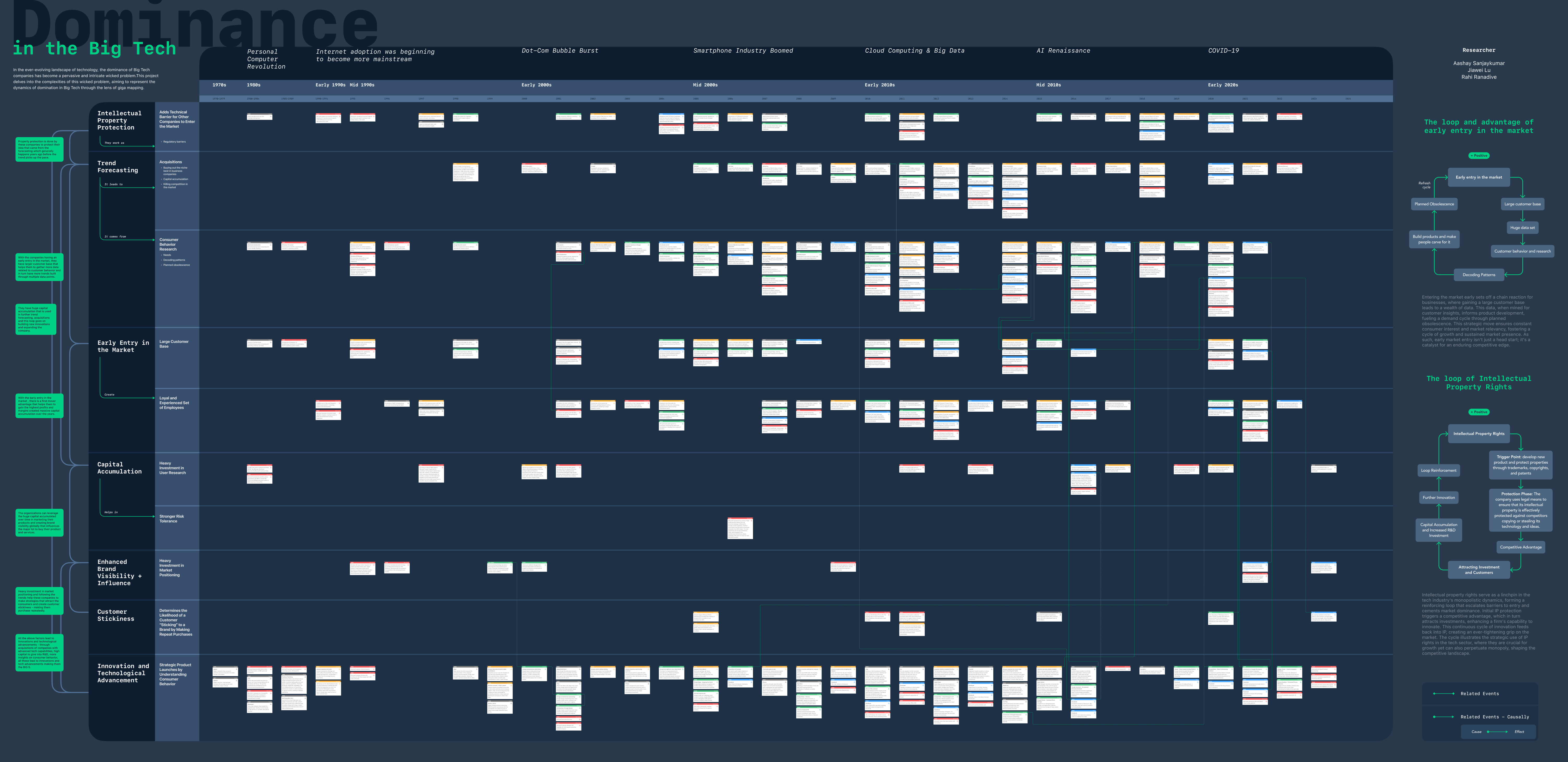
By mapping out a Gigamap (See Fig. 1), this essay reveals the triggering factors behind the monopolies of big tech companies—such as the protection of intellectual property, early market entry, and capital accumulation—and their feedback loops. It discusses how changes in rules and goals can promote both short-term and long-term transformations.
The Positive Feedback Loops Behind Monopolies
Positive feedback loops are self-reinforcing processes where one change triggers another similar change, thereby amplifying the original effect (Dubberly and Pangaro 28). In the scenario of technological monopolies, these loops manifest as a series of mutually reinforcing business activities and market control strategies.
For instance, large tech companies leverage early market advantages to accumulate capital. This capital is then invested in product development, market expansion, and the acquisition and protection of intellectual property to maintain a technological lead. Such a leading position attracts more users, increasing the company’s data resources. These resources are used to enhance products and services, attract even more users, and increase market share and control.
Positive feedback is also evident in customer loyalty and brand influence. By entering the market early, tech giants have established strong brands and user bases, increasing customer loyalty. This raises the barriers to market entry for new competitors, who must contend with both product quality and the established brand reputation. This not only strengthens the monopolistic position of large companies but could also diminish market competitiveness over time.
Reflection and Principles of Systems Thinking
Recognizing capitalism’s dual role in both advancing technological and economic development and leading to market monopolies and related issues is crucial for a deep understanding of the situation. However, when facing complex systemic problems, we should avoid falling into a dichotomy of choices, but rather seek win-win strategies that creatively leverage the tension between differing viewpoints (Ryan 6). Thus, in seeking strategies to resolve market monopolies, it’s not necessary to completely abandon capitalism or turn towards socialism, but to explore a creative path. This path involves maintaining the efficiency and innovation incentives of capitalism, while ingeniously designing systems that can mitigate its adverse effects (See Fig. 2).


Swift Strategies: Changing System Rules
In tackling the dominance wielded by tech behemoths, a swift and efficient approach lies in altering the system’s rules, especially enhancing “data portability” and “interoperability”. Measures like the European Union’s Digital Markets Act aim to render the market more equitable and competitive (“Digital Markets Act”), enabling users to select services based on product quality, sustainability, or other considerations (“EU Digital Markets Act”). Data portability permits users to transfer personal details from one platform to another, diminishing reliance on a singular platform. Interoperability, on the other hand, guarantees seamless integration between diverse services and platforms, offering users more options and thereby stimulating wider competition.
Though rule changes represent a significant step forward and can promptly elicit visible reactions, they might not suffice for fundamentally altering monopolistic market phenomena over the long term. This is because large tech firms often discover new ways to adapt to or circumvent these changes, thus continuing to sustain their market dominance (Lomas). For example, they might develop algorithms that skirt these policies or elevate service quality to bolster brand loyalty. When Apple enacted the sideloading requirements of the Digital Markets Act, it essentially restricted the benefits for developers distributing apps via alternative channels by instituting specific mechanisms and fee rules, indirectly preserving its market position (“Apple Announces Changes”; Perez). Moreover, major corporations could lure users with more personalized services (Leachman and Scheibenreif), and even with enhanced data portability, users might be reluctant to switch platforms (Kranz et al. 597). Companies could also retain control over target entities by adjusting their internal structures, like creating independent subsidiaries, to ostensibly comply with rules while actually maintaining control.
This strategic adaptability of businesses mirrors a core model in cybernetics—the positive feedback loop, a closed-loop relationship where actions and changes mutually influence each other, aimed at achieving the system’s goals (Dubberly and Pangaro 36). Therefore, without altering the structure of the positive feedback loop, mere rule changes are unlikely to fundamentally resolve the issue of monopolies (See Fig. 3).


More Sustainable Strategies: Changing the System’s Structure and Goals
To address the monopoly issues posed by tech giants in a more sustainable manner, it goes beyond adjusting rules to fundamentally changing the system’s structure and goals. According to systems thinking theorist Donella Meadows, enhancing the system’s capacity for self-organization and altering its goals are more effective intervention methods than merely adjusting its rules (Meadows 1999). Such profound transformations aim to break the current monopoly patterns, fostering healthy market competition while ensuring social welfare and environmental sustainability.
Changing the Power to Affect System Structure
This level of leverage points emphasizes the flexibility and adaptability of the system’s internal structure, highlighting that a system’s power originates from the way its structure is organized. This capability can be achieved through innovation and self-organization to evolve and improve the system. Therefore, the following specific measures can be envisioned.
Establishing a flexible regulatory framework. Technology and science often evolve at a pace that can outstrip regulatory mechanisms (“Regulating What Comes Next”), necessitating a paradigm shift in decision-making and management regarding emerging technological challenges (OECD 2021). Creating a regulatory framework that can adapt to rapidly changing market and technological environments can limit excessive capital concentration without stifling innovation.
Developing models to differentiate business types. By including factors such as revenue and user volume, models that can determine business indicators, such as size, can be established, thereby providing a basis for grading different businesses. These gradings would be reassessed periodically to reflect the latest conditions. A grading system lays the foundation for the implementation of differentiated policies and has the flexibility to adapt to market changes. Similarly, French economist Thomas Piketty proposed a global progressive wealth tax system in Capital in the Twenty-First Century to help reduce inequality and prevent the majority of wealth from being controlled by a minority (Piketty).
Redefining the distribution of accumulated capital. Capital accumulation is a key factor in the positive feedback loop and is crucial for emerging enterprises not entering the market early. For enterprises classified as large tech companies, a specific proportion of their capital must be directed towards smaller-scale tech companies with growth potential. Technically, this would be evaluated by a dedicated organization. Changing the flow of accumulated capital can weaken the positive feedback loop, thus reducing the speed and extent of capital accumulation.
Promoting open innovation and the sharing economy. Open innovation holds immense potential for creating shared value for business and society, rooted in the belief that spreading knowledge and cooperating with stakeholders results in win-win outcomes for all parties involved (Camilleri et al. 4485-4486). Encouraging enterprises, research institutions, and individuals to share knowledge and technology through policies and incentive measures fosters broader social participation and collaborative innovation.
Changing the Goals of the System
An unrestrained free market can lead to the concentration of wealth (Smith). As revealed in the Gigamap, a key trigger of monopolies is “capital accumulation,” driven by large corporations primarily aiming to maximize shareholder profits, directly fueling capital concentration and market power imbalance. However, the ultimate goal of an economy should be to enhance the overall welfare of the nation, not merely the accumulation of wealth (Smith). To alter this state, it’s necessary to realign the objectives of businesses and the economic system toward broader social welfare, environmental sustainability, privacy protection, and long-term economic health. Specifically, this means corporate decisions need to consider their long-term impact on society, the environment, and the economy, rather than focusing solely on short-term financial returns. Consequently, the following specific measures can be envisioned.
Changing goals through diverse business models. The traditional corporate model emphasizes maximizing shareholder profit as its primary goal, often leading to suppressed competition and market monopolies, while promoting competition is widely regarded as the best policy for increasing social welfare (Davis and Orhangazi 6). In contrast, business models like cooperatives and social enterprises focus more on social welfare and sustainable development (NCBA CLUSA). Cooperatives do not tie decision-making rights to capital ownership but grant them based on membership (Billiet et al.). These models, through their business operations, directly reflect social and environmental goals, thereby introducing diversity to the market with the potential to break the positive feedback loop driven by capital accumulation. To implement this approach, governments can encourage the development of these business models by offering tax incentives, entrepreneurial funding, and preferential procurement policies. Additionally, raising public awareness is crucial. Educating and promoting the value of cooperatives and social enterprises can enhance consumer and investor support for these businesses. Finally, establishing support networks is necessary. For instance, creating dedicated incubators and accelerators to provide necessary resources, training, and networks to social enterprises and cooperatives can help them grow and expand.
Strengthening corporate social responsibility. Encouraging businesses to go beyond legal requirements by actively taking measures to protect the environment, provide fair working conditions, protect privacy and limit excessive data collection, and support community development not only helps improve the company’s social image but also enhances its market competitiveness by building stronger community ties and consumer trust.
Higher Levels of Social Transformation
To address the monopoly issues posed by large tech companies over a more extended period, it is necessary to consider second-level (the mindset or paradigm out of which the system arises) and first-level (the power to transcend paradigms) strategies (Meadows 1999). These levels of transformation require us to boldly question and redefine the meaning of “success” and how this success can be achieved globally.
Such profound transformations are both complex and challenging, necessitating interdisciplinary research, citizen engagement, and the courage of policymakers. Through collective efforts, we can move toward a future that is more equitable, sustainable, and inclusive.
Conclusion
To tackle technological monopolies, immediate rule changes and long-term systemic reforms are essential for fostering fair competition and innovation. This balanced approach aims to build a digital economy that benefits everyone.
Works Cited
“Apple Announces Changes to iOS Safari and the App Store in the European Union.” Apple Newsroom, 25 Jan. 2024, Link. Accessed 3 Apr. 2024.
Billiet, Adrien, et al. “The Resilience of the Cooperative Model: How Do Cooperatives Deal with the COVID‐19 Crisis?” Strategic Change, vol. 30, no. 2, 2021, pp. 99–108. Link.
Camilleri, Mark Anthony, et al. “Creating Shared Value through Open Innovation Approaches: Opportunities and Challenges for Corporate Sustainability.” Business Strategy and the Environment, vol. 32, no. 7, Nov. 2023, pp. 4485-4502. Link.
Davis, Leila, and Özgür Orhangazi. “Competition and Monopoly in the US Economy: What Do the Industrial Concentration Data Show?” Competition & Change, vol. 25, no. 1, 2021, pp. 3-30. Link.
“Digital Markets Act.” European Commission, Link. Accessed 26 Mar. 2024. Archived at Link.
Dubberly, Hugh, and Paul Pangaro. Introduction to Cybernetics and the Design of Systems. 2010.
Horst W. J. Rittel, and Melvin M. Webber. “Dilemmas in a General Theory of Planning.” Policy Sciences, vol. 4, no. 2, 1973, pp. 155–69.
Kranz, J., et al. “Data Portability.” Business & Information Systems Engineering, vol. 65, 2023, pp. 597–607. Link.
Leachman, Leah, and Don Scheibenreif. “Using Technology to Create a Better Customer Experience.” Harvard Business Review, 17 Mar. 2023, Link.
Lomas, Natasha. “Europe’s DMA Rules for Big Tech Explained.” TechCrunch, 7 Mar. 2024, Link. Accessed 3 Apr. 2024.
Meadows, Donella H. Leverage Points: Places to Intervene in a System. The Sustainability Institute, 1999.
NCBA CLUSA. “Advantages of the Cooperative Business Model.” NCBA CLUSA, 1 July 2022, Link.
OECD. OECD Regulatory Policy Outlook 2021. OECD Publishing, 2021. Link.
Peredo, A. M., Haugh, H. M., and McLean, M. “Common Property: Uncommon Forms of Prosocial Organising.” Journal of Business Venturing, vol. 33, no. 5, 2018, pp. 591–602. Link.
Perez, Sarah. “Apple Revises Its DMA Rules After Pressure but Keeps the Core Technology Fee Intact.” TechCrunch, 5 Mar. 2024, Link. Accessed 3 Apr. 2024.
Piketty, Thomas. Capital in the Twenty-First Century. Translated by Arthur Goldhammer, The Belknap Press of Harvard University Press, 2014.
“Regulation and Innovation: Can Sandbox Models Help?”. Roche, 9 Jun. 2023, Link. Accessed 3 Apr. 2024.
Ryan, Alex. “A Framework for Systemic Design.” Formakademisk, vol. 7, no. 4, 2014.
Smith, Adam. The Wealth of Nations. Penguin Classics, 1982.
“The EU Digital Markets Act: Is Interoperability the Way Forward?” Global Partners Digital, 14 July 2022, Link. Accessed 3 Apr. 2024. Archived at Link.