
Lose Attention? Track It
ADHD adults can now monitor symptom trends over time, identify what strategies work, and stay in control.
This project is a submission to the Apple Swift Student Challenge 2025.
ADHD Tracker is a self-assessment tool based on standardized evaluation scales, designed to help individuals with ADHD better understand their attention patterns by tracking symptom changes over time.
Problem
ADHD affects millions of adults, yet remains widely underestimated and misunderstood.
ADHD (Attention Deficit Hyperactivity Disorder) is a common neurodevelopmental condition.
In the U.S., an estimated 6% of adults live with ADHD. However, 80% of them are undiagnosed and struggle to access meaningful support.
$87–138 Billion
Annual economic loss in the U.S. due to ADHD (Doshi, et al., 2012)
The impact of ADHD extends far beyond distraction; it involves executive dysfunction, time blindness, and emotional regulation challenges. In adults, where hyperactivity is often less visible, ADHD is frequently misinterpreted as laziness or a lack of discipline—when in fact, these challenges stem from neurological differences.
ADHD affects not just attention, but every aspect of life.




Not everyone gets the chance to be seen or understood.
The path to an ADHD diagnosis is shaped by systemic inequalities:
- Women are frequently misdiagnosed with anxiety, as their symptoms are often internalized and less disruptive. Many only receive a correct diagnosis in adulthood.
- Black and Hispanic adults are diagnosed at significantly lower rates than white adults, even when symptoms are comparable—reflecting gaps in healthcare access, cultural bias, and structural discrimination.
- Low-income individuals face greater barriers to diagnosis and treatment, often trapped in a cycle of economic and psychological hardship.
When the struggle is vague and long-term, evaluation is often either out of reach—or gone in a blink.
Adults with ADHD are not free from challenges, nor are they unwilling to face them. The problem is: they don’t know where to begin, and they lack the tools to keep going.
Struggles without a name
Most adults with ADHD are never formally diagnosed. They spend years battling attention issues, procrastination, and disorganized work, without realizing these may stem from ADHD. Clinical resources are scarce, and the diagnostic threshold is high—leaving many stuck in a fog of confusion and self-blame.
The forgotten curve
Even after becoming aware of their ADHD, many still lack tools to continuously track their symptoms. Attention levels fluctuate with stress, environment, and sleep—but without consistent data, they’re left guessing, unable to see patterns over time.
No way to know what works
Many adults try strategies like the Pomodoro technique, task breakdown, or workspace adjustments. But without objective feedback, it’s hard to tell what’s actually helping. They struggle to stay consistent or adjust in time.
When you can’t see your own progress, you can’t fine-tune your approach.
Insight
Without tracking change, it’s impossible to know what works—and easy to stay stuck in the cycle of “good” and “bad” days.
Many people with ADHD experience the impact of symptoms long before receiving a formal diagnosis. Even after diagnosis, they often lack tools for long-term tracking or evaluating the effectiveness of their coping strategies.
ADHD is not a one-time issue—it’s a condition that fluctuates over time. Yet current evaluation tools are largely static, offering only snapshots rather than ongoing insight. As a result, individuals are forced to rely on subjective feelings to judge their state. Without data, it’s difficult to identify patterns in attention or assess which strategies are actually helping.
If people with ADHD could see how their attention shifts over time, they could take a more proactive role in managing it. This would not only help them identify what works, but also give them a greater sense of agency over their day-to-day experience.




Define
How might we make it easier for adults with ADHD to evaluate their symptoms—and track them over time?
Ongoing struggles deserve ongoing understanding. The goal isn’t to design a one-time assessment, but to create a continuous conversation.


Ideation
Diverge → Converge: When the problem becomes clear, the design must become focused.
After exploring a wide range of ideas—including voice logging, behavior tracking, calendar integration, community support, and gamification—I mapped all concepts onto a Feasibility vs. User Value matrix to evaluate which solutions would deliver the greatest impact within limited resources.
The final direction centers on structured scale-based assessments and automatic trend tracking.
This approach is low-barrier, clearly scoped, and offers long-term value—making it well-suited as a standalone app.
Principles
In the midst of chaos and fluctuation, order should come from understanding—not control.
This app should be built on four design principles that align with the cognitive patterns of people with ADHD, fostering clarity, trust, and long-term support.
Structured, not overwhelming
ADHD thinking is often nonlinear. The interface avoids information overload and guides users through the assessment with minimal cognitive load.
Data that serves the user
Results are presented clearly and intuitively, with trend feedback that helps users understand changes over time and adjust their management strategies.
Privacy by design
Assessments involve sensitive health information. All data is stored following best privacy practices to ensure safety and long-term accessibility.
Empowering understanding and trust
The design is grounded in scientific evidence, offering transparent background information to help users grasp the purpose of each assessment and support long-term ADHD care.
These principles shape ADHD Tracker not just as an assessment tool, but as a supportive system for ongoing self-awareness and attention tracking.
User Journey
Diagnosis is a judgment; tracking is a path to understanding. Without sustained presence and connection, real change cannot happen. Measurement isn’t for dividing—it’s for seeing.
Elliot, 29, a data scientist
His work relies heavily on logical reasoning and data insights, but he often finds himself overwhelmed when switching tasks, focusing during meetings, or organizing complex projects. He suspects he may have ADHD but has never been formally diagnosed. He’s looking for a way to track his state and evaluate whether the strategies he’s been trying in daily life are truly helping.
First launch
One night after working late, Elliot downloaded and opened ADHD Tracker. The app invited him to take a self-assessment to help understand his current attention state.
Completing the assessment and receiving initial results
In just a few minutes, he completed all 18 questions. Based on the standardized scale, the app calculated a score and indicated that his results might be related to ADHD. For the first time, Elliot gained a structured understanding of his attention challenges, clearly seeing where he stood among four scoring levels.
Trying out strategies
Over the next few weeks, he researched ADHD management techniques online—such as the Pomodoro method, task prioritization, and time boxing. He kept adjusting his strategies in daily life, but struggled to tell which ones were actually helping.
Reassessment and noticing change
A month later, Elliot received a notification and returned to the app for a second assessment. His score had slightly improved compared to the first time. The trend visualization showed that his condition was improving—he could “see” the difference for the first time.
Ongoing tracking and understanding fluctuations
In the following months, Elliot continued taking the assessment monthly. Through consistent tracking, he realized that not all strategies worked equally well for him. The feedback mechanism helped him understand the sources of fluctuation and adjust accordingly.
Reflection and a sense of control
The app became a tool for understanding, not judgment. He no longer relied solely on how he felt to judge his state—instead, he made decisions based on data. Through repeated testing and reflection, he gradually discovered the pace and methods that worked best for him.
Prototype for MVP
To prioritize the core value and validate the primary user flow early, I scoped the first version of the prototype as an MVP (Minimum Viable Product).
I used Figma to design the interface, allowing for rapid iteration and clear communication of the concept. Assuming iOS as the initial platform, I strategically leveraged Apple’s official iOS Design Kit and SF Symbols to improve efficiency while maintaining platform consistency and a familiar user experience.
Tip for Browsing
Turn on dark mode (if supported) to preview the prototype screens below in dark mode.
This strategic focus allowed me to balance efficiency, usability, and alignment with the iOS design language.
Vague no more. The shape of your score.
ADHD Tracker uses the ASRS v1.1 scale—a widely recognized ADHD screening tool—to help users assess their attention and organizational challenges. Through 18 questions, users receive an instant score, and a severity category to better understand where they stand.


Attention moves. Tracking moves with it.
Each completed assessment is stored locally and presented in a history log. Users can review past results and detailed responses to spot patterns and track how their attention evolves.


Your data stays on your device.
All user data is stored locally—never uploaded to the cloud. While the app is not a HIPAA-regulated medical tool, its design follows best privacy practices to ensure data remains secure and private. ADHD Tracker is intended solely as a self-assessment tool and does not offer medical diagnosis or advice.


Develop
Coding for a seamless experience.
I chose to develop the project in Swift Playground to make it easy for more people to try out and test.
ADHD Tracker is built using Swift, with the interface developed in SwiftUI and local storage used for data management. This ensures an efficient assessment flow, smooth interaction, and privacy-conscious data handling.

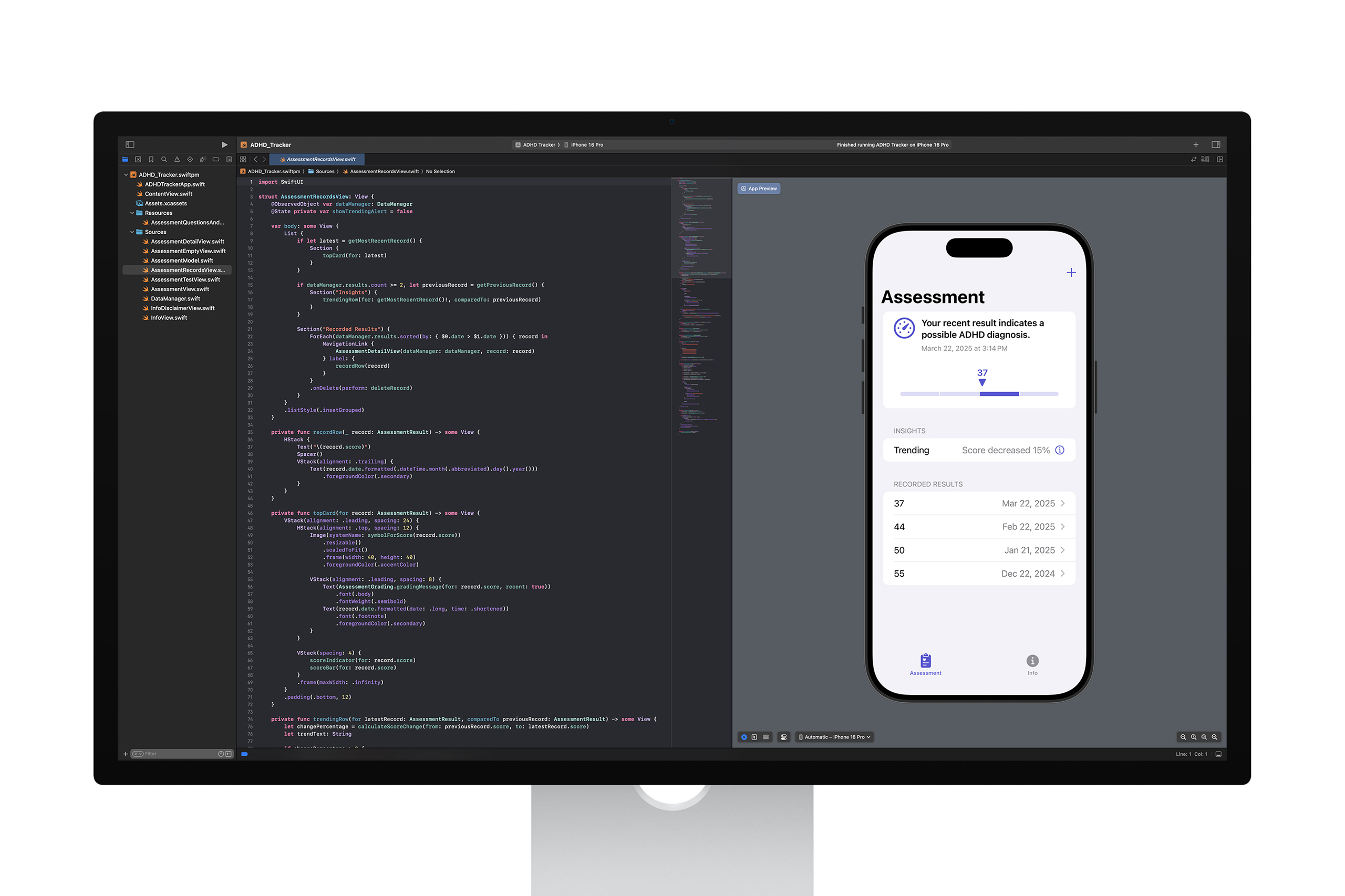
Reactive state management for stable interactions
Leveraged ObservableObject, SwiftUI’s reactive state management system, to bind user input with UI updates. This ensures a consistent and smooth assessment experience without manual UI refreshes.
UI updates are decoupled from data logic, minimizing unnecessary re-renders and enhancing responsiveness during assessments.
Local storage for privacy-first data handling
Assessment records are stored using UserDefaults, a lightweight and secure local storage method, keeping all user data entirely on-device.
A centralized DataManager module handles data read/write operations, ensuring stability and avoiding performance bottlenecks.
Modular architecture for scalability
The codebase is organized into modular components, including the assessment system, user interface, data storage, and privacy information—each with clearly defined responsibilities to improve reusability and maintainability.
Logic and UI are decoupled: AssessmentQuestionsAndGrading handles scoring logic, while views like AssessmentTestView and AssessmentRecordsView manage user-facing components. This separation enables easy expansion for future features like data visualization.
Conclusion
Intersection of design, technology, and mental health.
More than a technical exercise, it was a cross-disciplinary exploration that brought together design thinking, mental health research, and user experience practice—focusing on how digital tools can support ADHD assessment and long-term tracking.
Courses from my graduate program—such as Design for Behavior Change and Design and Mental Health—offered valuable theoretical grounding for this project, helping me understand how to create tools that can meaningfully influence user behavior.
Looking ahead, ADHD Tracker could serve as a foundation for broader ADHD research or personal health management tools, empowering more users to build self-awareness and adjust their behaviors with confidence.
Download and experience it.
If you’re interested in experiencing ADHD Tracker, you’re welcome to try it out. You can open it with the Swift Playgrounds app on iPad or Mac, or run it in Xcode on macOS.
Reference
ADDA Editorial Team. (2023, July 24). Impact of ADHD at work. Attention Deficit Disorder Association. https://add.org/impact-of-adhd-at-work/
Agarwal, R., Goldenberg, M., Perry, R., & IsHak, W. W. (2012). The quality of life of adults with attention deficit hyperactivity disorder: a systematic review. Innovations in clinical neuroscience, 9(5-6), 10–21.
Babinski, D. E. (2024). Sex differences in ADHD: Review and priorities for future research. Current Psychiatry Reports, 26(4), 151–156. https://doi.org/10.1007/s11920-024-01492-6
Gjervan, B., & Nordahl, H. M. (2010). The Adult ADHD Quality of Life Questionnaire (AAQoL). Nordic Psychology, 62(1), 24–36. https://doi.org/10.1027/1901-2276/a000003
Haack, L. M., Meza, J., Jiang, Y., Araujo, E. J., & Pfiffner, L. (2018). Influences to ADHD Problem Recognition: Mixed-Method Investigation and Recommendations to reduce Disparities for Latino youth. Administration and Policy in Mental Health and Mental Health Services Research, 45(6), 958–977. https://doi.org/10.1007/s10488-018-0877-7
KESSLER, R. C., ADLER, L., AMES, M., DEMLER, O., FARAONE, S., HIRIPI, E., … WALTERS, E. E. (2005). The World Health Organization adult ADHD self-report scale (ASRS): a short screening scale for use in the general population. Psychological Medicine, 35(2), 245–256. doi:10.1017/S0033291704002892
Loh, H. W., Ooi, C. P., Barua, P. D., Palmer, E. E., Molinari, F., & Acharya, U. R. (2022b). Automated detection of ADHD: Current trends and future perspective. Computers in Biology and Medicine, 146, 105525. https://doi.org/10.1016/j.compbiomed.2022.105525
Quiroz, J. D. M., & Stutts, L. A. (2025). An experimental investigation of stigma toward attention-deficit/hyperactivity disorder in the Hispanic/Latinx community. Stigma and Health. https://doi.org/10.1037/sah0000623
Skogli, E. W., Teicher, M. H., Andersen, P. N., Hovik, K. T., & Øie, M. (2013). ADHD in girls and boys – gender differences in co-existing symptoms and executive function measures. BMC Psychiatry, 13(1). https://doi.org/10.1186/1471-244x-13-298
Staley, B. S., Robinson, L. R., Claussen, A. H., Katz, S. M., Danielson, M. L., Summers, A. D., Farr, S. L., Blumberg, S. J., & Tinker, S. C. (2024). Attention-Deficit/Hyperactivity Disorder Diagnosis, Treatment, and Telehealth Use in Adults — National Center for Health Statistics Rapid Surveys System, United States, October–November 2023. MMWR Morbidity and Mortality Weekly Report, 73(40), 890–895. https://doi.org/10.15585/mmwr.mm7340a1
Wender, P. H., Wolf, L. E., & Wasserstein, J. (2001). Adults with ADHD. Annals of the New York Academy of Sciences, 931(1), 1–16. https://doi.org/10.1111/j.1749-6632.2001.tb05770.x
Yamashita, T., & Millar, R. J. (2021). Likert scale. In D. Gu & M. E. Dupre (Eds.), Encyclopedia of Gerontology and Population Aging. Springer. https://doi.org/10.1007/978-3-030-22009-9_559